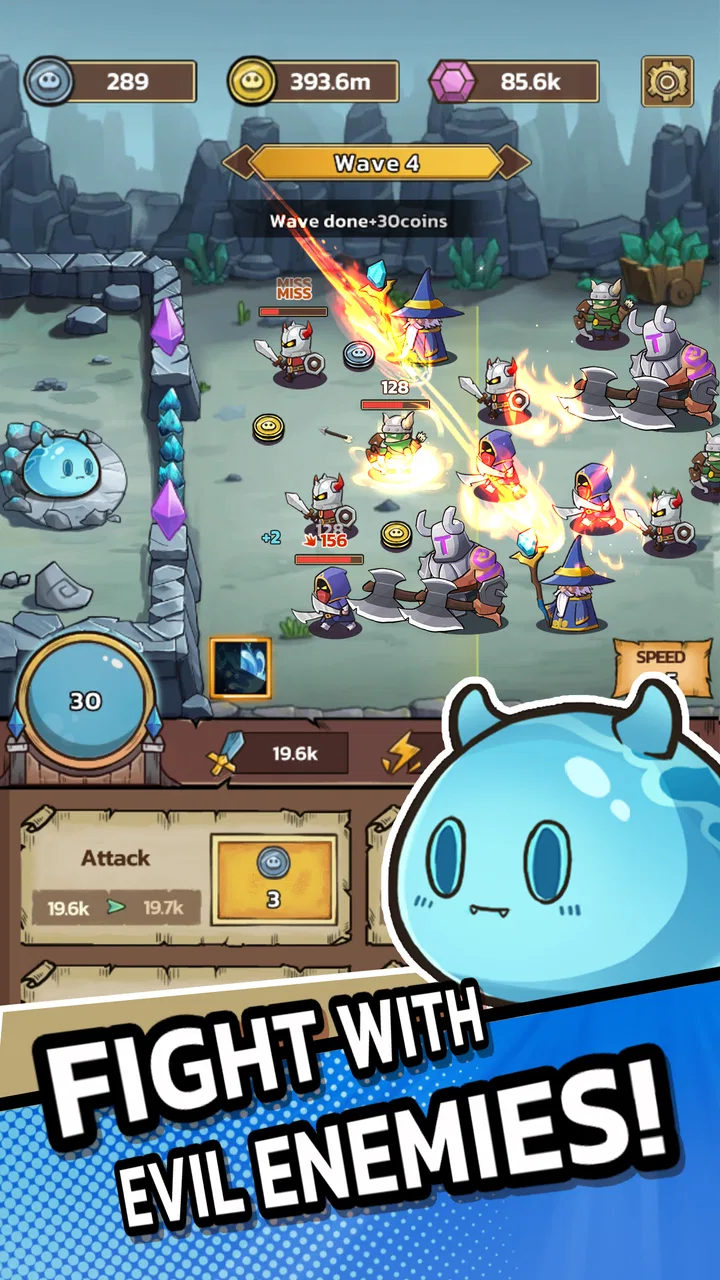
Slime Castle — Idle TD Game
- 4.6
- Rating
- 1.00M
- Installs
- Free
- Price

 Analysis by App-foxy
I went into Slime Castle expecting a lightweight tower-defense game that would mostly play itself, and that is broadly what I found. The difference is that its idle format does not remove decision-making; it changes when those decisions matter. Instead of constantly placing towers or reacting to every second of a match, I spent more time deciding how to prepare the forest’s defense, when to improve my strength, and whether a difficult push was worth attempting now or later.
That makes this a useful choice for players who enjoy strategy in short sessions. I could check progress, make a few upgrades, start another defense, and leave the game without feeling that I had missed an entire complicated battle. At the same time, anyone looking for a highly interactive tower-defense experience may find the automatic elements too restrictive. My overall impression is that this is a patient planning game wearing the friendly appearance of a slime adventure.
How the idle format changes your decisions
The central idea is simple: you play as a slime hero protecting the forest from invading humans. The setting gives the game a clear personality, but the more important design choice is the balance between direct action and background progress. In a traditional tower-defense game, I usually focus on placement, timing, enemy paths, and immediate responses. Here, the meaningful choices are more often about preparation and efficiency.
You May Also Like

 Blood Strike: 2.5 Anniversary
Blood Strike’s Loadouts Turn Every Drop Into a Tactical Gamble
A close look at Blood Strike’s custom loadouts: how fast access to signature weapons reshapes its battle royale rhythm, rewards preparation, and narrows the gap between fights.

 Pandora - Music & Podcasts
Pandora’s Music Is Easy to Start, but Harder to Recover
Pandora’s strength is its low-effort path from a seed to a station. Its weak spot is how much confidence it asks you to place in connection, setup, and quiet recovery.

 8 Ball Pool
 Is Built on Rivalries, Rematches, and Routine
A close look at the rivalries, rematches, shared routines, and unanswered safety questions that turn a quick pool match into a persistent mobile community.

 Samsung Music
’s Quiet Strength Is Playing What You Already Own
Its reach comes less from spectacle than from dependable access to a personal library. That simplicity is both the app’s strongest retention engine and its ceiling.

 AccuWeather: Weather Radar
AccuWeather Review: A Quick, Clear Forecast for Everyday Decisions
For everyday plans, the best forecast is the one you can understand quickly. AccuWeather makes rain timing, radar, and local conditions easy to act on, with a few trade-offs.

 Hill Climb Racing
Why Hill Climb Racing Still Turns Crashes Into One More Run
A tiny car, a bumpy hill and one more upgrade: Hill Climb Racing keeps resurfacing because its simple chaos makes every near-miss feel personal.
More From Our News Desk



That changes the rhythm considerably. A short visit can be enough to collect progress, strengthen the defense, and decide what challenge to tackle next. I did not need to reserve a long uninterrupted block of time, which makes the game fit naturally into a commute, a lunch break, or the few minutes before bed. The trade-off is that the satisfaction comes less from saving a round through quick reactions and more from seeing whether an earlier plan was strong enough.
I found it helpful to treat each session as a small planning cycle. First, I checked what had improved while I was away. Then I considered whether my current power was better spent on steady progress or on testing a harder stage. Finally, I made upgrades with the next obstacle in mind rather than spending everything immediately. That habit matters because idle games can make every reward feel interchangeable, while the best choices usually depend on what I expect to face next.
The game’s appeal is therefore not just “watch the numbers rise.” The interesting question is whether I should build a reliable base or gamble on faster advancement. A safe improvement can make future sessions smoother, but a more ambitious attempt may reveal that I am closer to the next breakthrough than I thought. I enjoyed that tension, especially when I had enough resources for one meaningful decision rather than several minor purchases.
Planning before pushing forward
One of my most useful habits was resisting the urge to spend every reward as soon as it appeared. In an idle strategy game, immediate upgrades feel productive, but saving for a more important improvement can produce a better result over several sessions. I started asking myself whether a purchase would solve the problem in front of me or merely make the current stage look slightly easier.
This is also where the game separates casual progress from thoughtful progress. A player can certainly tap through rewards and continue moving, but a player who watches the relationship between preparation and difficulty will get more from it. I paid attention to whether a failed attempt suggested a genuine power shortage or simply showed that I had chosen a poor moment to advance. That distinction prevents wasted resources and gives each return visit a clear purpose.
For everyday play, I would use a simple routine. I would collect what had accumulated, review the next available challenge, and choose one goal for the session. That goal might be improving the defense, reaching a new point in the campaign, or building enough reserve for a later attempt. Keeping the objective narrow made the game feel less like a checklist and more like a sequence of manageable strategic decisions.
This approach is especially useful for people who dislike games that demand constant attention. I could make a decision, close the app, and return later without needing to remember a complicated real-time situation. However, that convenience comes with less control. If you want to personally direct every defensive action, this format may feel more like management than tower defense.
Where the risk comes from
The risk-and-reward structure is modest but meaningful. Pushing onward can improve the pace of progress, yet an attempt made too early may leave me with less flexibility afterward. Waiting is not exciting, but it can make the next session more dependable. I liked that the game encouraged me to think in terms of momentum rather than treating every stage as an isolated event.
My preferred approach was to avoid spending resources simply because they were available. I tried to identify a threshold: if an upgrade would clearly change my ability to handle the next challenge, it was worth prioritizing; if it only offered a small comfort, I often waited. This is a small distinction, but it gives the idle loop more texture than a basic “upgrade everything” system.
There is also a psychological risk in the way idle games present progress. Returning to a larger pile of rewards feels satisfying, and it is easy to confuse that feeling with actual strategic improvement. I found that the better question was not how much I had collected, but whether the collection solved a specific obstacle. That mindset helped me avoid aimless spending and made my progress easier to evaluate.
The free entry point is another part of the trade-off. Slime Castle can be played without an upfront purchase, while optional in-app items range from $0.99 to $124.99 per item. That wide range is worth keeping in mind before spending. I would recommend deciding on a personal limit before getting invested, because the desire to speed up progress can become more persuasive when the game is built around waiting and returning.
I do not see spending as necessary for understanding the game’s basic appeal, but players who dislike any pressure toward optional purchases should approach carefully. The safest way to enjoy it is to treat paid items as entirely separate from the core decision process. If a purchase starts replacing planning rather than supporting it, the game loses much of the challenge that makes it interesting.
Adapting instead of repeating the same plan
Idle games can become repetitive when one successful routine works forever. My experience with this one was better when I treated each setback as information. If a defense could not handle the next push, I did not automatically repeat the same attempt. I reconsidered whether I had advanced too soon, whether my resources were spread too thin, or whether I had focused on a short-term improvement instead of a durable one.
That kind of adaptation is the game’s strongest strategic lesson. The forest-defense theme is charming, but the real challenge is learning when your current plan has stopped being efficient. A strategy that feels comfortable during early progress may become expensive later. I found more satisfaction in changing my priorities than in simply accumulating enough strength to overpower every obstacle.
My advice is to keep a mental note of the reason behind each failed attempt. “Not strong enough” is too vague to guide the next decision. A more useful conclusion is that the next push requires patience, a better reserve, or a different upgrade target. Even without turning the game into a spreadsheet, this small amount of reflection makes each return more purposeful.
This is also where the game compares favorably with many casual alternatives. A purely passive idle title may offer a pleasant stream of rewards but little reason to reconsider your approach. A conventional tower-defense game usually gives more moment-to-moment control, yet it can punish interruptions and require repeated manual attention. Slime Castle sits between those styles: it offers planning without demanding that every battle become a performance test.
The compromise will not suit everyone. Players who enjoy arranging defenses tile by tile, experimenting with exact attack ranges, or reacting to enemy movement may prefer a traditional tower-defense game. On the other hand, players who want a strategy game that respects short visits may appreciate the reduced pressure. I would describe it as a better fit for planners who like gradual improvement than for tacticians who need constant control.
What keeps the loop interesting over time
The long-term depth comes from the relationship between idle accumulation and active choices. Background progress gives me a reason to return, but it does not automatically tell me how to use what I earned. That gap is important. Without it, the game would be little more than a reward collector; with it, there is at least some room to develop a personal rhythm.
I noticed three useful planning horizons. The first is the immediate session: what can I improve or attempt right now? The second is the next return: what should I prepare before closing the game? The third is the longer objective: which kind of progress will make future obstacles less costly? Thinking across those horizons stopped me from making decisions that looked good for one minute but slowed me down afterward.
A realistic example would be playing during a busy weekday. I might open the game while waiting for a meeting, collect the accumulated rewards, and see that a new challenge is within reach but not guaranteed. Instead of spending everything on small upgrades, I could make one focused improvement and leave the rest for the next visit. Later, when I have more time, I would test the challenge and use the result to decide whether to keep building or continue forward.
That workflow is more satisfying than repeatedly checking the game without a plan. It also makes the idle element feel useful rather than intrusive. The game becomes a series of decisions separated by ordinary life, not a demand to remain permanently engaged. For me, that was the clearest sign that the format worked.
Still, the long-term loop may feel thin if you need constant novelty. The basic appeal depends on enjoying gradual growth, repeated evaluation, and the occasional breakthrough. If you quickly lose interest when the main activity is upgrading a character and returning later, the friendly theme may not be enough to carry the experience.
Who should play it, and who should skip it
I would recommend this strategy game to someone who enjoys the idea of tower defense but does not always have the time or patience for a fully manual version. It is also a good match for players who like making small, informed decisions and watching those decisions pay off across several visits. The slime hero concept keeps the presentation approachable, while the idle structure makes the game easy to fit around a normal schedule.
It is less suitable for anyone seeking a competitive, reaction-heavy experience. If your favorite part of strategy games is precise placement under pressure, Slime Castle may feel too hands-off. I would also hesitate to recommend it to players who strongly dislike optional purchase systems, particularly because the listed individual purchase range extends from small amounts to much larger ones.
The age rating is Everyone 10+, and the game is free to start. It was released on May 3, 2024, and the current version is 2.9.4, with Android support beginning at version 6.0. Those details make it accessible to a broad range of mobile users, but practical compatibility is only one part of the decision. The more important question is whether you enjoy a slower strategic cadence.
Azur Interactive Games Limited has positioned the game in a familiar mobile category, yet the result is not simply a copy of a standard tower-defense session. Its identity comes from combining forest defense, slime-themed presentation, and idle progression. That combination will appeal to some players precisely because it lowers the workload, while others will see the same feature as a loss of control.
My strategy verdict after settling into the rhythm
After spending time with it, I see Slime Castle as a pleasant planning game rather than a deep manual tower-defense simulator. Its best moments come when I make a deliberate choice, leave the game, return with new resources, and discover whether the plan worked. That loop rewards patience and observation more than speed.
The game also benefits from a clear practical identity. I can play it in short bursts, keep a longer-term objective in mind, and avoid the feeling that missing one session ruins everything. For a mobile strategy game, that is a real strength. It respects the interruptions that are normal on a phone, even if the reduced interaction means some traditional tower-defense fans will want more direct involvement.
My main caution is to maintain control over the pace, especially around optional spending. Do not let accumulated rewards or a difficult stage pressure you into choices you would not otherwise make. The most enjoyable version of the game is the one where progress comes from planning first and acceleration second.
With a 4.6 average from around 65 thousand ratings and more than a million installs, it has clearly found an audience. I can understand why: the concept is easy to grasp, the sessions are flexible, and the strategic decisions are approachable without being completely empty. I would not call it the right choice for every tower-defense player, but I would recommend it to anyone who wants a relaxed, slime-themed strategy game with an idle backbone and enough planning to make each return feel intentional.
FAQs for Slime Castle — Idle TD Game
01What is the main objective of Slime Castle — Idle TD Game?
In Slime Castle — Idle TD Game, your primary goal is to defend your castle from waves of slime creatures. As a player, you strategically place defensive towers and upgrade them to withstand increasingly challenging waves. The game combines elements of strategy and idle gaming, allowing players to progress even when offline.
02Is Slime Castle suitable for all age groups?
Slime Castle is designed to be family-friendly and suitable for most age groups. The game's graphics and gameplay mechanics are simple yet engaging, making it accessible to younger audiences while still providing enough challenge for older players. However, parental guidance is recommended for very young children due to strategic elements.
03Does Slime Castle require an internet connection to play?
Slime Castle primarily functions as an offline game, allowing players to enjoy gameplay without an internet connection. However, certain features, such as in-game purchases or leaderboards, may require a connection. This makes it convenient for gaming on the go without worrying about connectivity issues.
04What are the in-app purchase options in Slime Castle?
Slime Castle offers various in-app purchases to enhance the gaming experience. Players can buy currency packs to speed up progress, unlock special towers, or gain other beneficial items. While the game is free to play, these purchases can provide an edge, although they are entirely optional and not necessary to enjoy the full game.
05How do I upgrade my towers in Slime Castle?
Upgrading towers in Slime Castle is crucial for progressing through tougher levels. Players can upgrade towers by spending in-game currency earned during battles. Each upgrade increases a tower's strength and abilities, allowing more effective defense against stronger slime waves. The game also provides guidance to help players optimize their upgrade strategies.
Pros
- Engaging tower defense mechanics
- Colorful
- whimsical graphics
- Frequent updates and new content
- Offline play available
- Rewarding progression system
Cons
- In-app purchases can be pricey
- Some levels feel repetitive
- Occasional performance lags
- Ads can be intrusive
- Limited multiplayer features

Slime Castle — Idle TD Game
Gallery